Pixel art of Chinese food

Cuisine Guide

Chinese Food

Eight regional cuisines, more than a billion people, and a thousand-year head start on technique — a guide to the dishes that define Chinese cooking.

Chinese food is not a cuisine, it's a federation. The country has eight officially recognized regional cooking traditions — Cantonese, Sichuan, Shandong, Jiangsu, Zhejiang, Fujian, Hunan, and Anhui — and within each, dozens of subdivisions tied to a city, river, or mountain range. A dish from Chengdu and a dish from Guangzhou will share almost no ingredients in common.

What ties everything together is technique. Wok hei — "the breath of the wok" — is the smoky char that comes from cooking food fast over a screaming-hot, well-seasoned wok, the food sometimes flaming as it leaves the pan. Knife work is treated as art; cuts are matched to cooking method. Five flavors — sweet, sour, bitter, salty, and umami — are balanced inside a single dish or across a meal.

This guide leans on the dishes that travel — the ones any first-time eater is likely to encounter, plus a handful that hint at the depth waiting inside each regional cuisine. Cantonese and Sichuan dominate the global imagination but every line below has another twenty dishes behind it.

12 Iconic Chinese Dishes

Track every one in your Nomrade food passport.

Pixel art of Peking Duck

Peking Duck

Beijing's lacquered roast

A whole duck, air-pumped under the skin to separate it from the meat, glazed with a maltose syrup, and roasted hanging in a wood-fired oven until the skin lacquers to a deep mahogany shine. The skin is the prize — sliced off in strips and eaten first, with sugar or a dab of hoisin. Then the meat is sliced and rolled into thin Mandarin pancakes with scallion and cucumber. Three courses from one bird: skin, pancakes, and finally a soup made from the carcass. A 600-year-old imperial dish.

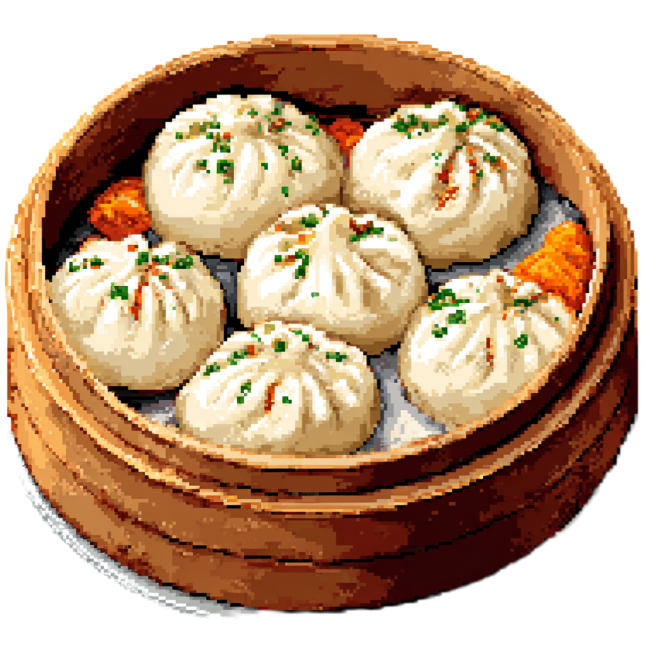
Pixel art of Xiaolongbao

Xiaolongbao

Shanghai soup dumplings

Pleated dumplings filled with seasoned pork and a cube of cold, jellied broth that melts into hot soup once steamed. The wrapper is rolled paper-thin and gathered into 18 to 32 perfect pleats at the top — count them, the experts do. Eaten with care: lift gently with chopsticks, place on a soup spoon, bite a small hole, drink the broth, then eat the dumpling with black vinegar and slivered ginger. Originally from Nanxiang, a suburb of Shanghai. A burn on the roof of your mouth is part of the cost.

Pixel art of Mapo Tofu

Mapo Tofu

Sichuan's numbing-spicy classic

Soft silken tofu cubes simmered in a deep red sauce of doubanjiang (fermented broad bean paste), fermented black beans, ground beef or pork, garlic, ginger, and a heavy hand of Sichuan peppercorns — which produce , the tongue-tingling numbness that pairs with , the chile heat. The dish reportedly takes its name from a pockmarked widow (Po-mar) who served it at a Chengdu restaurant in the 1860s. Served over rice. Looks aggressive; rewards bravery.

Pixel art of Hot Pot

Hot Pot

Communal simmering pot

A pot of broth simmering at the center of the table, often split into two compartments — one mild, often a clear chicken or mushroom broth, the other a fiery Sichuan mala broth red with chiles and floating peppercorns. Diners cook their own ingredients: thin-sliced beef and lamb, fish balls, lotus root, leafy greens, tofu skin, fresh noodles. Each diner builds their own dipping sauce from sesame paste, soy, scallion, garlic, cilantro, and chile oil. Eats slow, runs late, ends with everyone slightly sweaty.

Pixel art of Kung Pao Chicken

Kung Pao Chicken

Sichuan stir-fry with peanuts

Diced chicken stir-fried over high heat with dried red chiles, Sichuan peppercorns, scallion, garlic, ginger, and roasted peanuts in a savory-sweet-vinegary sauce. Originally from the Qing dynasty governor of Sichuan, a man named Ding Baozhen, whose title was Gong Bao ("palace guardian") — phoneticized abroad as "Kung Pao." The American restaurant version drowns it in sugar and red food coloring; the original is leaner, sharper, more peppercorn-forward.

Pixel art of Dim Sum

Dim Sum

Cantonese small plates

An entire meal genre, not a single dish. Bite-sized portions served in bamboo steamers and small plates, designed for tea drinking. The classics: har gow (translucent shrimp dumplings), siu mai (open-topped pork dumplings), char siu bao (BBQ pork buns), cheung fun (rice noodle rolls), egg tarts, chicken feet in black bean sauce, lo bak go (turnip cake), and dozens more. The tradition started as roadside snacks for travelers on the Silk Road and refined into the elaborate Hong Kong tea-house ritual.

Pixel art of Dumplings (Jiaozi)

Dumplings (Jiaozi)

Northern China's pleated parcels

Wheat-flour wrappers folded around a filling of ground pork, chives, cabbage, shrimp, or any number of variations, then boiled, pan-fried (guotie, potstickers), or steamed. A dipping sauce of black vinegar, soy, sesame oil, and chili oil sharpens each bite. Eaten especially on Lunar New Year's Eve, when families gather to fold thousands together — the shape is meant to mirror old Chinese ingots, a symbol of wealth. Different fillings carry different luck.

Pixel art of Char Siu

Char Siu

Cantonese BBQ pork

Strips of pork shoulder marinated in a sticky-sweet glaze of hoisin, soy sauce, honey, Chinese five-spice, and red fermented bean curd, then roasted on hooks in a tall oven until the edges char and the surface lacquers reddish-brown. Sliced and served over rice with steamed greens, or stuffed into pillowy char siu bao buns. Hung in restaurant windows up and down every Cantonese street in the world. Sweet, fatty, slightly burnt, ideal.

Pixel art of Wonton Soup

Wonton Soup

Cantonese dumplings in broth

Small, ruffly dumplings filled with ground pork and shrimp, wrapped in thin wheat skins, simmered briefly in a clear pork-and-chicken broth and served with leafy greens. The Hong Kong version comes with thin egg noodles in the same bowl — a dish called wonton mein. The wonton wrapper is thinner than a dumpling's and the ratio leans broth-heavy. A breakfast and late-night staple in Cantonese cooking; a homestyle classic that travels well.

Pixel art of Fried Rice

Fried Rice

Wok-tossed leftovers, perfected

Day-old rice — fresh rice is too wet — broken up by hand and stir-fried over screaming heat with egg, scallion, soy sauce, and whatever protein was around: char siu, shrimp, chicken, sometimes nothing. The grains separate, take on a faint smoky wok hei, and absorb seasoning fast. Yangzhou fried rice is the classic version, with shrimp, char siu, peas, carrot, and egg. The American version with brown soy sauce is a different dish; authentic fried rice keeps the rice mostly white.

Pixel art of Hong Shao Rou

Hong Shao Rou

Mao's favorite red-braised pork

Pork belly cubes simmered slowly in soy sauce, rock sugar, Shaoxing wine, ginger, scallion, and star anise until the sauce reduces into a glossy, candy-glazed coat and the pork falls apart at a chopstick touch. The fat goes silky; the meat goes mahogany. A homestyle dish across China but most famously associated with Hunan, where Chairman Mao made it part of his personal mythology. Served over a mound of rice that catches every drop of the braising liquid.

Pixel art of Bubble Tea

Bubble Tea

Taiwan's chewy export

Black or green tea shaken with milk and sugar, poured over chewy tapioca pearls (boba) the size of marbles, drunk through a fat straw. Invented in Taichung, Taiwan in the 1980s and now a global phenomenon — boba shops have opened in every major city in the world. The tea-and-milk base has spawned endless variations: cheese foam tops, brown sugar pearls, fruit teas with popping pearls, oat milk versions. Texture is the entire point.

How Chinese Eat

Chinese meals are family-style. Rice is your bowl; everything else is shared on the table. You don't take what you want all at once — you pick a single piece with chopsticks, eat it, then go back. Stabbing chopsticks straight down into rice is taboo (it mimics incense at funerals). Tapping the table with two fingers is a quiet thank-you when someone pours your tea.

Yum cha — "drinking tea" — is the Cantonese tradition of brunchy tea-and-dim-sum sessions. Carts roll past your table all morning loaded with bamboo steamers; you pick what looks good. Pork buns, har gow shrimp dumplings, siu mai, chicken feet, custard tarts. The bill is calculated by counting the empty steamers stacked on the table.

Hot pot is the country's most communal meal, especially in Sichuan and Chongqing. A bubbling pot of broth at the center of the table — sometimes split into two halves, mild and mala spicy — and everyone cooks their own thin-sliced beef, lamb, fish balls, mushrooms, and vegetables on the spot. Dipping sauces are personal; there's no wrong way to build one.

Track Your Chinese Food Journey

Nomrade turns every meal into a stamp in your food passport. Snap a photo of the peking duck you tried last week, the xiaolongbao on the menu tonight, the dish your friend keeps recommending — and Nomrade marks each iconic Chinese dish off your list, unlocking badges as you go. It's a calorie counter, recipe saver, and food journal in one — built for people who think eating well means eating widely.