Pixel art of Japanese food

Cuisine Guide

Japanese Food

From the precision of Edomae sushi to the slurpy chaos of a Hakata ramen counter — a guide to the dishes that define Japanese cooking.

Japanese food has two operating modes. The first is restraint — the kaiseki tradition, where a chef serves you 10 small courses built around what was caught or harvested that morning, and where the empty space on the plate matters as much as what's on it. The second is comfort — ramen, katsudon, gyudon, the stuff that fuels a country of commuters and salarymen at lunch counters that haven't redecorated since 1978.

The throughline is umami, the savory fifth taste that Japan named. It comes from dashi, the kelp-and-bonito broth at the foundation of nearly every Japanese soup, sauce, and braise. It comes from soy sauce, miso, mirin, and sake — the four pillars of Japanese seasoning. It comes from the ferment of fish (katsuobushi, ikura) and rice (sake, vinegar). It is why a single bowl of plain rice in Japan can taste better than a four-course meal somewhere else.

This guide is the iconic-dish version of the country: the things every visitor wants to try once and the things every Japanese person eats without thinking about it.

12 Iconic Japanese Dishes

Track every one in your Nomrade food passport.

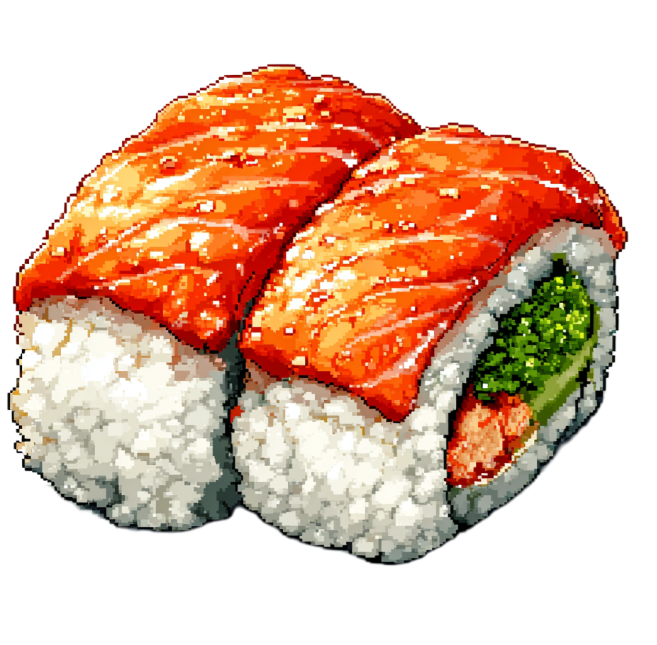
Pixel art of Sushi

Sushi

Edo-style vinegared rice

Vinegared, slightly sweetened short-grain rice (shari) topped with raw fish or shellfish (nigiri), rolled with seaweed (maki), or layered in a bowl (chirashi). The Edomae style — the modern bench-mark — was developed in 19th-century Tokyo as a fast street food, with rice originally cured in vinegar to extend its life before refrigeration. A good itamae shapes nigiri in a few seconds with hands trained for years; the rice should fall apart on the tongue but hold together perfectly until that moment.

Pixel art of Ramen

Ramen

The four-broth empire

Wheat noodles in a broth, with toppings. The broth is the personality: tonkotsu (Hakata-style pork bone, milky white, simmered 12+ hours), shoyu (Tokyo-style soy-based, clear amber), miso (Sapporo-style, opaque, deep), shio (Hakodate-style salt, the cleanest). Topped with chashu pork, soft-boiled marinated egg, scallion, menma bamboo, nori, and sometimes corn or butter in the north. Originally a Chinese import in the early 1900s; now arguably Japan's most globally beloved dish.

Pixel art of Tempura

Tempura

Lightly battered fried bites

Shrimp, white fish, kabocha squash, eggplant, shiso leaves, mushroom, sweet potato — dipped in a cold, lumpy batter (cold water and flour, mixed barely, never smooth) and fried in clean sesame or vegetable oil at the right moment. The result is the lightest, lacy-crisp coating, almost shatteringly thin, with the vegetable or shrimp inside still tasting purely of itself. Served with a tentsuyu dipping sauce of dashi, soy, and mirin, plus grated daikon. A Portuguese-influenced dish (16th-century Jesuit traders brought the technique) refined into something only Japan would call its own.

Pixel art of Tonkatsu

Tonkatsu

Breaded fried pork cutlet

A thick pork loin or fillet, salted, dredged in flour, dipped in egg, packed in panko breadcrumbs, and fried until the breading shatters under your fork. Served sliced into strips with shredded raw cabbage, a bowl of rice, miso soup, and a thick, sweet-tangy sauce called tonkatsu sauce that's somewhere between Worcestershire and brown ketchup. The panko is the key — the bread is sliced from the crust-less interior of a square loaf, dried, and ground into long, jagged shards that fry up airier than any other breadcrumb.

Pixel art of Okonomiyaki

Okonomiyaki

Osaka's savory pancake

Cabbage, flour, dashi, egg, scallion, pickled ginger, and protein — usually pork belly, shrimp, squid, or all three — mixed into a thick batter and griddled like a pancake. Topped after cooking with a sweet-savory okonomi sauce, Kewpie mayo, bonito flakes that flutter in the steam, and dried seaweed. Hiroshima-style is layered instead of mixed and includes yakisoba noodles. The name means "grilled how you like it" — at most restaurants, you cook it yourself on a teppan grill in front of you.

Pixel art of Tonkotsu Ramen

Tonkotsu Ramen

Hakata's pork bone broth

A specific style of ramen worth its own entry. Pork bones — femurs, knuckles, and trotters — are simmered at a rolling boil for 12 to 24 hours, breaking the marrow and collagen down into a milky, almost gravy-thick broth. Served with extra-thin, firm wheat noodles called kaedama that you can order seconds of. Toppings are minimal: a slice of chashu, scallion, sesame seed, pickled mustard greens. From Fukuoka, where it's eaten at outdoor yatai stalls. The most addictive bowl in the country.

Pixel art of Yakitori

Yakitori

Charcoal-grilled chicken skewers

Bite-sized pieces of chicken — not just thigh and breast, but skin, liver, heart, gizzard, cartilage, the tail (bonjiri) — skewered on bamboo and grilled over Japanese binchotan charcoal, which burns clean and intensely hot. Glazed with tare (a sweet soy sauce reduction) or simply seasoned with salt. Eaten with cold beer at a yakitori-ya, a smoky neighborhood bar where the cook works behind a long charcoal trough and orders are called out one skewer at a time.

Pixel art of Takoyaki

Takoyaki

Octopus balls

Osaka street food. A loose batter of flour, eggs, and dashi is poured into a special cast iron pan with hemispherical molds, filled with diced octopus, pickled ginger, and tenkasu (tempura crumbs), then rotated with metal picks until each ball forms a perfect sphere — crispy on the outside, molten and pancake-y inside. Topped with takoyaki sauce, mayo, bonito flakes, and aonori. Famously dangerous to eat right off the grill — the inside is essentially lava.

Pixel art of Tamagoyaki

Tamagoyaki

Rolled omelette

A thin omelette of egg, dashi, soy sauce, mirin, and sometimes sugar, cooked in a rectangular Japanese skillet. Each layer is poured in thin, half-cooked, then rolled forward; another layer of egg fills the empty pan, gets cooked, and rolled into the previous one. The result is a striped, multi-layered cake of egg with a soft, almost custardy texture. Eaten as a breakfast side, packed into bento boxes, or served as the closing piece of a sushi meal — a chef's tamagoyaki is sometimes how diners judge his skill.

Pixel art of Karaage

Karaage

Japanese fried chicken

Bite-sized pieces of bone-in or boneless chicken thigh marinated in soy sauce, sake, ginger, and garlic, then dredged in potato starch (sometimes mixed with flour) and double-fried until lacquered crisp. The starch creates a thinner, glassier crust than wheat flour. Served with a wedge of lemon to squeeze and a dollop of Kewpie mayonnaise. Standard at every izakaya in Japan and the most-ordered dish at convenience-store hot food counters.

Pixel art of Mochi

Mochi

Sticky rice cake

Glutinous rice steamed and pounded — traditionally in a wooden mortar with mallets, in a process called mochitsuki — until it forms a smooth, elastic, taffy-like dough. Cut into rounds or squares and eaten plain (grilled in soup at New Year), filled with sweet red bean paste (daifuku), or wrapped around ice cream for the export-friendly version. The texture is the signature: chewy bordering on dangerous; mochi is responsible for a small but real number of choking deaths in Japan every January.

Pixel art of Onigiri

Onigiri

Triangle rice balls

A handful of cooked short-grain rice, lightly salted, shaped into a triangle around a filling — pickled plum, salmon flakes, kelp, tuna mayo, kombu — and wrapped with a strip of nori. Nori is sealed in a separate compartment in convenience-store versions so it stays crisp until you peel the wrapper open. The Japanese answer to a sandwich. Found at every konbini, eaten by every salaryman and student, embedded so deep in daily life that a Japanese person will probably eat several thousand in a lifetime.

How Japanese Eat

Japanese eating runs on rituals you mostly don't notice. You say itadakimasu before a meal and gochisousama after. You don't stick chopsticks upright in rice — that's how rice is offered to the dead at funerals. You don't pass food chopstick-to-chopstick for the same reason. You do slurp noodles loudly; it cools the broth and signals enjoyment.

A traditional Japanese meal is built on ichiju-sansai — "one soup, three sides" — plus rice. A bowl of miso, a piece of grilled fish, a simmered vegetable, a pickle, a bowl of rice. This template scales up to formal kaiseki and down to a salaryman's teishoku set lunch. The Western model of one big plate as a meal is recent and still feels foreign in much of Japan.

Regional cuisines are sharp. Osaka is the country's street food capital — okonomiyaki, takoyaki, kushikatsu. Hokkaido leans seafood and dairy thanks to its colder climate. Kyoto perfected the polite, vegetable-forward kaiseki tradition. Fukuoka invented tonkotsu ramen. Each place is worth a separate trip and a separate hunger.

Track Your Japanese Food Journey

Nomrade turns every meal into a stamp in your food passport. Snap a photo of the sushi you tried last week, the ramen on the menu tonight, the dish your friend keeps recommending — and Nomrade marks each iconic Japanese dish off your list, unlocking badges as you go. It's a calorie counter, recipe saver, and food journal in one — built for people who think eating well means eating widely.